
Artificial Christmas Tree Buying Guide for Importers
Importing artificial Christmas trees involves much more than comparing unit prices. For wholesalers, distributors and retailers, the right product needs to balance appearance, cost, packaging efficiency, compliance and seasonal delivery.
Before placing an order, buyers should first define the target market and retail positioning. PVC trees are generally more cost-effective and suitable for mass retail, while PE and PE/PVC mixed trees offer a more realistic appearance and are often preferred for mid-range and premium collections.
1. Choose the Right Material
PVC Christmas Trees
PVC trees are lightweight, economical and easy to pack in large quantities. They are widely used by supermarkets, wholesalers and promotional programs.
PE Christmas Trees
PE branches are injection-molded to create a more realistic needle shape and texture. They are ideal for premium retailers, hotels and high-end seasonal collections.
PE/PVC Mixed Trees
Mixed construction combines realistic PE tips with PVC filler branches, offering a good balance between appearance and cost.
2. Check Branch Construction
Artificial Christmas trees are commonly available in wrapped, hook-on and hinged constructions.
Wrapped trees are usually more economical and compact for shipping. Hook-on trees use detachable branches that are installed manually, while hinged trees offer faster setup and a better consumer experience.
For retail programs, hinged construction is often preferred when convenience is an important selling point.
3. Confirm Size, Tip Count and Fullness
Tree height alone does not determine appearance. Buyers should also compare tip count, tree diameter and branch density.
For the same 7.5FT tree, two models can look completely different depending on how the branches are distributed. Importers should request actual product photos, branch details and sample confirmation before bulk production.
4. Review Lighting and Certifications
For pre-lit Christmas trees, lighting requirements vary by market.
Buyers should confirm the required electrical standards, plug type, voltage and certification before production. CE-compliant lighting may be required for European markets, while UL-certified lighting is commonly requested for North America.
5. Evaluate Packaging Efficiency
Packaging has a major impact on landed cost.
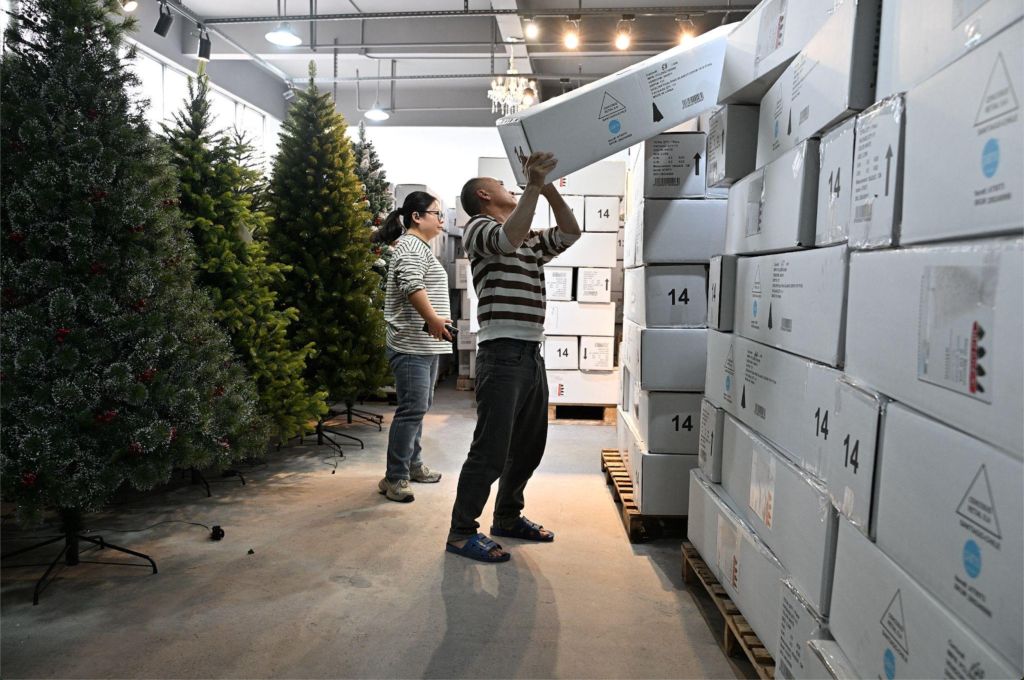
Before confirming an order, buyers should check carton dimensions, gross weight, container loading quantity and whether the tree structure can be optimized to reduce cubic volume.
Efficient packaging can significantly improve freight cost per unit, especially for large seasonal programs.
6. Confirm MOQ and Production Lead Time
Christmas tree production is highly seasonal. Importers should confirm MOQ, sample lead time, production schedule and latest acceptable shipment date early in the sourcing process.
Large retail programs are usually planned months before the selling season, so production capacity and delivery reliability are just as important as price.
7. Check OEM and Private Label Capability
For buyers developing their own collections, a reliable factory should support customization of:
- Tree height and diameter
- PVC / PE material combinations
- Tip count and branch density
- Flocking
- LED lighting
- Carton and color box design
- Labels and manuals
- Private branding
8. Work With a Reliable Supplier
The lowest quotation is not always the lowest total cost.
Stable quality, accurate specifications, efficient packaging, clear communication and reliable delivery can reduce much more risk than a small unit-price difference.
At XSHUN, we provide PVC, PE/PVC mixed, full PE, flocked and pre-lit artificial Christmas trees for wholesalers, importers and private label programs, with OEM customization and export packaging support.
For buyers planning the next Christmas season, early product development and sample confirmation can make sourcing significantly more efficient.